JEE Main 2026 — Amines Question with Solution
JEE Main 2026 (02 April Shift 1)
Question
Consider the three aromatic molecules (P, Q and R) whose structures have been given below :
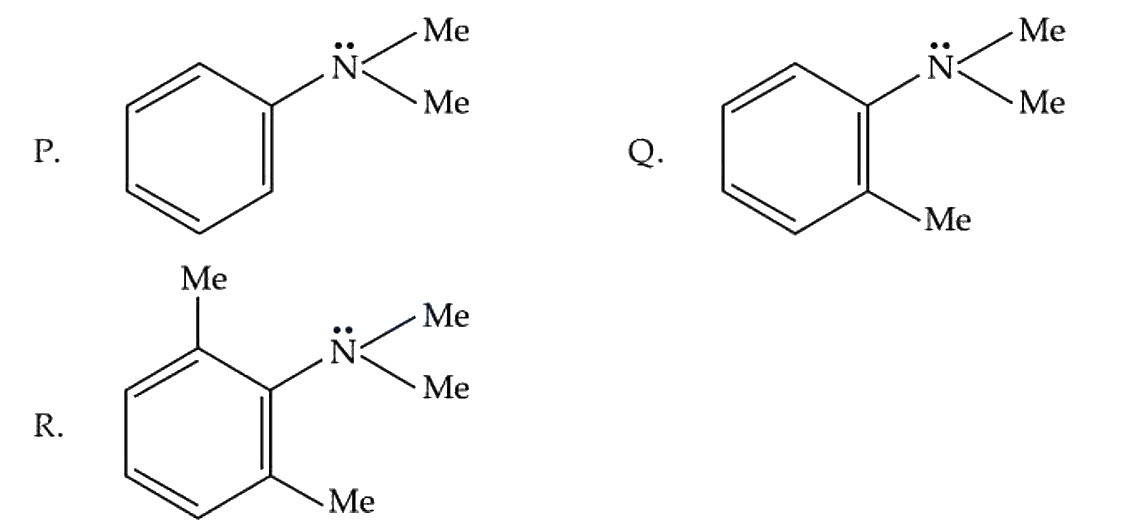
The correct order regarding the reactivity of these compounds with under optimum but slightly acidic medium is :
The correct order regarding the reactivity of these compounds with under optimum but slightly acidic medium is :
Choose an option
Show full solutionCorrect option: A
Correct answer
A
Step-by-step explanation
The reaction of the given aromatic compounds with benzenediazonium chloride () is an azo coupling reaction, which is a type of electrophilic aromatic substitution.
The electrophile, the diazonium ion (), is a weak electrophile and requires a strongly activated aromatic ring to undergo coupling. The reactivity of the ring depends on its electron density, which is enhanced by the (mesomeric) effect of the group.
1. In molecule P (N,N-dimethylaniline), the group is coplanar with the benzene ring. The lone pair on the nitrogen atom is fully delocalized into the ring, providing a strong effect and making the ring highly electron-rich and reactive.
2. In molecule Q, there is one methyl group at the ortho position to the group. This causes steric hindrance, forcing the group slightly out of the plane of the benzene ring. This phenomenon is known as Steric Inhibition of Resonance (SIR). As a result, the delocalization of the nitrogen lone pair into the ring is reduced, decreasing the effect and making it less reactive than P.
3. In molecule R, there are two methyl groups at the ortho positions. This causes severe steric repulsion, forcing the group almost completely out of the plane of the ring. The effect is minimized because the lone pair can no longer effectively overlap with the -system of the ring. Consequently, the ring is the least activated among the three.
Therefore, the electron density on the aromatic ring and the reactivity towards electrophilic substitution follow the order: P Q R.
Answer:
The electrophile, the diazonium ion (), is a weak electrophile and requires a strongly activated aromatic ring to undergo coupling. The reactivity of the ring depends on its electron density, which is enhanced by the (mesomeric) effect of the group.
1. In molecule P (N,N-dimethylaniline), the group is coplanar with the benzene ring. The lone pair on the nitrogen atom is fully delocalized into the ring, providing a strong effect and making the ring highly electron-rich and reactive.
2. In molecule Q, there is one methyl group at the ortho position to the group. This causes steric hindrance, forcing the group slightly out of the plane of the benzene ring. This phenomenon is known as Steric Inhibition of Resonance (SIR). As a result, the delocalization of the nitrogen lone pair into the ring is reduced, decreasing the effect and making it less reactive than P.
3. In molecule R, there are two methyl groups at the ortho positions. This causes severe steric repulsion, forcing the group almost completely out of the plane of the ring. The effect is minimized because the lone pair can no longer effectively overlap with the -system of the ring. Consequently, the ring is the least activated among the three.
Therefore, the electron density on the aromatic ring and the reactivity towards electrophilic substitution follow the order: P Q R.
Answer:
Practice this on the real CBT interface
Solve this JEE Main question (and the rest of the Amines chapter) on PrepSharp's TCS iON-style CBT player — with timer, bookmarks and session analytics.
Solve interactively →About this question
This is a previous-year question from JEE Main 2026, covering the Amines chapter of Chemistry. PrepSharp catalogues every PYQ from JEE Main with a verified answer key and step-by-step solution prepared by IIT alumni — so you can search by chapter, topic or year and revise efficiently.