JEE Main 2026 — Laws of Motion Question with Solution
JEE Main 2026 (28 January Shift 1)
Question
A particle of mass falls from rest through a resistive medium having resistive force, , where is the velocity of the particle and is a constant. Which of the following graphs represents velocity () versus time ()?
Choose an option
Show full solutionCorrect option: A
Correct answer
A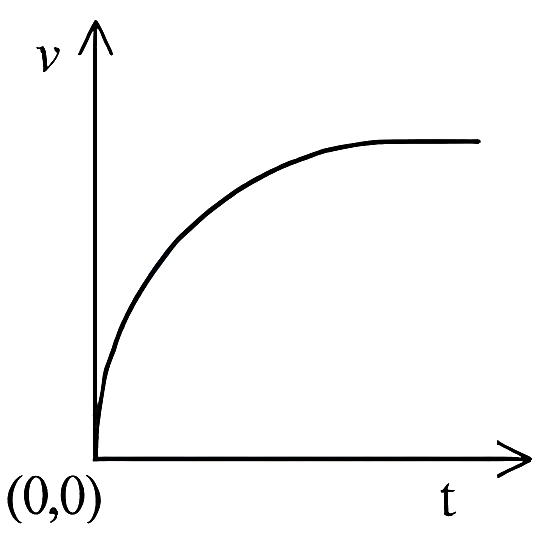
Step-by-step explanation
The particle experiences downward gravitational force (mg) and upward resistive force (-kv).
The equation of motion is .
Initially at , gives maximum acceleration .
As velocity increases, the resistive force increases, reducing the net acceleration.
Eventually the particle reaches terminal velocity when acceleration becomes zero.
The velocity-time graph shows an increasing curve starting from origin with decreasing slope, asymptotically approaching the terminal velocity.
This behavior matches option (1), which displays a curve starting at (0,0) with steep initial slope that gradually flattens.
The equation of motion is .
Initially at , gives maximum acceleration .
As velocity increases, the resistive force increases, reducing the net acceleration.
Eventually the particle reaches terminal velocity when acceleration becomes zero.
The velocity-time graph shows an increasing curve starting from origin with decreasing slope, asymptotically approaching the terminal velocity.
This behavior matches option (1), which displays a curve starting at (0,0) with steep initial slope that gradually flattens.
Practice this on the real CBT interface
Solve this JEE Main question (and the rest of the Laws of Motion chapter) on PrepSharp's TCS iON-style CBT player — with timer, bookmarks and session analytics.
Solve interactively →About this question
This is a previous-year question from JEE Main 2026, covering the Laws of Motion chapter of Physics. PrepSharp catalogues every PYQ from JEE Main with a verified answer key and step-by-step solution prepared by IIT alumni — so you can search by chapter, topic or year and revise efficiently.