JEE Main 2026 — Alcohols Phenols and Ethers Question with Solution
JEE Main 2026 (06 April Shift 2)
Question
Consider the following reaction.
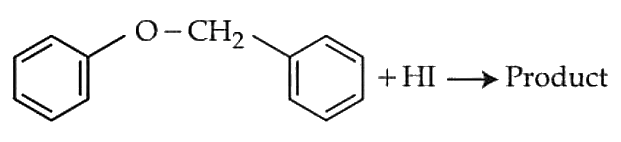
Statement I : In the above reaction, product formed will be a mixture of benzyl alcohol and iodobenzene.
Statement II : In the above reaction, the bond is cleaved to give the product.
In the light of the above statements, choose the correct answer from the options given below :
Statement I : In the above reaction, product formed will be a mixture of benzyl alcohol and iodobenzene.
Statement II : In the above reaction, the bond is cleaved to give the product.
In the light of the above statements, choose the correct answer from the options given below :
Choose an option
Show full solutionCorrect option: D
Correct answer
DStatement I is false but Statement II is true
Step-by-step explanation
The given reactant is phenyl benzyl ether ().
When it reacts with , the ether oxygen is first protonated to form an oxonium ion. The cleavage of the ether linkage then takes place.
The bond has partial double bond character due to the resonance of the oxygen's lone pair with the benzene ring, making it strong and difficult to break. On the other hand, the bond is a weaker single bond. Moreover, cleavage of the bond can proceed via a highly stable benzyl carbocation (in an mechanism) or undergo facile attack by the iodide ion () at the less sterically hindered and activated benzylic carbon.
Therefore, the ion attacks the group, cleaving the bond. The products formed are phenol () and benzyl iodide ().
Statement I claims the products are benzyl alcohol and iodobenzene, which is incorrect. Thus, Statement I is false.
Statement II claims that the bond is cleaved to give the product, which is correct. Thus, Statement II is true.
Answer: Statement I is false but Statement II is true
When it reacts with , the ether oxygen is first protonated to form an oxonium ion. The cleavage of the ether linkage then takes place.
The bond has partial double bond character due to the resonance of the oxygen's lone pair with the benzene ring, making it strong and difficult to break. On the other hand, the bond is a weaker single bond. Moreover, cleavage of the bond can proceed via a highly stable benzyl carbocation (in an mechanism) or undergo facile attack by the iodide ion () at the less sterically hindered and activated benzylic carbon.
Therefore, the ion attacks the group, cleaving the bond. The products formed are phenol () and benzyl iodide ().
Statement I claims the products are benzyl alcohol and iodobenzene, which is incorrect. Thus, Statement I is false.
Statement II claims that the bond is cleaved to give the product, which is correct. Thus, Statement II is true.
Answer: Statement I is false but Statement II is true
Practice this on the real CBT interface
Solve this JEE Main question (and the rest of the Alcohols Phenols and Ethers chapter) on PrepSharp's TCS iON-style CBT player — with timer, bookmarks and session analytics.
Solve interactively →About this question
This is a previous-year question from JEE Main 2026, covering the Alcohols Phenols and Ethers chapter of Chemistry. PrepSharp catalogues every PYQ from JEE Main with a verified answer key and step-by-step solution prepared by IIT alumni — so you can search by chapter, topic or year and revise efficiently.