JEE Main 2025 — Oscillations Question with Solution
JEE Main 2025 (3 Apr Shift 1)
Question
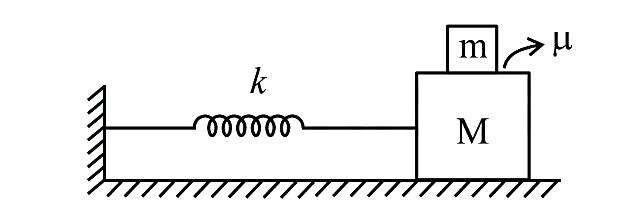
Two blocks of masses and , are placed on a frictionless table as shown in figure. A massless spring with spring constant k is attached with the lower block. If the system is slightly displaced and released then
( coefficient of friction between the two blocks)
(A) The time period of small oscillation of the two blocks is
(B) The acceleration of the blocks is ( displacement of the blocks from the mean position)
(C) The magnitude of the frictional force on the upper block is
(D) The maximum amplitude of the upper block, if it does not slip, is
(E) Maximum frictional force can be .
Choose the correct answer from the options given below:
( coefficient of friction between the two blocks)
(A) The time period of small oscillation of the two blocks is
(B) The acceleration of the blocks is ( displacement of the blocks from the mean position)
(C) The magnitude of the frictional force on the upper block is
(D) The maximum amplitude of the upper block, if it does not slip, is
(E) Maximum frictional force can be .
Choose the correct answer from the options given below:
Choose an option
Show full solutionCorrect option: A
Correct answer
AA, B, D Only
Step-by-step explanation
(A) As both blocks moving together so Time period where
(B) Let block is displaced by x in direction so force on block will be in(-ve) direction
$\begin{aligned}
& \mathrm{F}=-\mathrm{Kx} \\ & (\mathrm{M}+\mathrm{m}) \mathrm{a}=-\mathrm{Kx} \\ & \mathrm{a}=-\frac{\mathrm{Kx}}{(\mathrm{M}+\mathrm{m})}
\end{aligned}\mathrm{f}=\mathrm{ma}=\frac{\mathrm{mKx}}{(\mathrm{M}+\mathrm{m})}\begin{aligned}
& K A=(M+m) a \\ & a=\frac{K A}{(M+m)} \\ & f=m a=\frac{m K A}{(M+m)} \\ & f_{\max }=f_L=\mu \mathrm{mg} \\ & f=\mu m g \\ & \frac{m K A}{(M+m)}=\mu m g \\ & A=\frac{\mu(M+m) g}{K}
\end{aligned}\mu \mathrm{mg}$ as force is acting between blocks \& normal force here is mg.
(B) Let block is displaced by x in direction so force on block will be in(-ve) direction
$\begin{aligned}
& \mathrm{F}=-\mathrm{Kx} \\ & (\mathrm{M}+\mathrm{m}) \mathrm{a}=-\mathrm{Kx} \\ & \mathrm{a}=-\frac{\mathrm{Kx}}{(\mathrm{M}+\mathrm{m})}
\end{aligned}\mathrm{f}=\mathrm{ma}=\frac{\mathrm{mKx}}{(\mathrm{M}+\mathrm{m})}\begin{aligned}
& K A=(M+m) a \\ & a=\frac{K A}{(M+m)} \\ & f=m a=\frac{m K A}{(M+m)} \\ & f_{\max }=f_L=\mu \mathrm{mg} \\ & f=\mu m g \\ & \frac{m K A}{(M+m)}=\mu m g \\ & A=\frac{\mu(M+m) g}{K}
\end{aligned}\mu \mathrm{mg}$ as force is acting between blocks \& normal force here is mg.
Practice this on the real CBT interface
Solve this JEE Main question (and the rest of the Oscillations chapter) on PrepSharp's TCS iON-style CBT player — with timer, bookmarks and session analytics.
Solve interactively →About this question
This is a previous-year question from JEE Main 2025, covering the Oscillations chapter of Physics. PrepSharp catalogues every PYQ from JEE Main with a verified answer key and step-by-step solution prepared by IIT alumni — so you can search by chapter, topic or year and revise efficiently.