JEE Main 2026 — Biomolecules Question with Solution
JEE Main 2026 (04 April Shift 2)
Question
A D-aldotetrose on oxidation with concentrated resulted in optically inactive dicarboxylic acid. The structure of the D-aldotetrose is:
Choose an option
Show full solutionCorrect option: C
Correct answer
C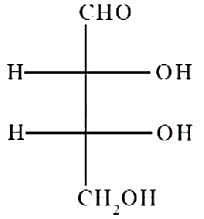
Step-by-step explanation
For a carbohydrate to be classified as a D-sugar, the hydroxyl () group on the lowest chiral carbon (C3 in the case of an aldotetrose) must be on the right side in its Fischer projection. This eliminates options (A) and (B), which are L-sugars.
Oxidation of an aldotetrose with concentrated converts both the aldehyde () group at C1 and the primary alcohol () group at C4 into carboxylic acid () groups, yielding a dicarboxylic acid (tartaric acid).
The problem states that the resulting dicarboxylic acid is optically inactive. This implies that the product must be a meso compound, which requires a plane of symmetry. For the dicarboxylic acid to possess a plane of symmetry, the groups on C2 and C3 must be on the same side in the Fischer projection.
Looking at the D-sugars:
Option (C) is D-erythrose. Upon oxidation, it forms meso-tartaric acid, which has a plane of symmetry and is optically inactive.
Option (D) is D-threose. Upon oxidation, it forms an optically active tartaric acid because it lacks a plane of symmetry.
Therefore, the correct structure of the D-aldotetrose is given in option (C).
Answer:
Oxidation of an aldotetrose with concentrated converts both the aldehyde () group at C1 and the primary alcohol () group at C4 into carboxylic acid () groups, yielding a dicarboxylic acid (tartaric acid).
The problem states that the resulting dicarboxylic acid is optically inactive. This implies that the product must be a meso compound, which requires a plane of symmetry. For the dicarboxylic acid to possess a plane of symmetry, the groups on C2 and C3 must be on the same side in the Fischer projection.
Looking at the D-sugars:
Option (C) is D-erythrose. Upon oxidation, it forms meso-tartaric acid, which has a plane of symmetry and is optically inactive.
Option (D) is D-threose. Upon oxidation, it forms an optically active tartaric acid because it lacks a plane of symmetry.
Therefore, the correct structure of the D-aldotetrose is given in option (C).
Answer:
Practice this on the real CBT interface
Solve this JEE Main question (and the rest of the Biomolecules chapter) on PrepSharp's TCS iON-style CBT player — with timer, bookmarks and session analytics.
Solve interactively →About this question
This is a previous-year question from JEE Main 2026, covering the Biomolecules chapter of Chemistry. PrepSharp catalogues every PYQ from JEE Main with a verified answer key and step-by-step solution prepared by IIT alumni — so you can search by chapter, topic or year and revise efficiently.