JEE Main 2026 — Biomolecules Question with Solution
JEE Main 2026 (06 April Shift 2)
Question
Consider the following reactions. Total number of electrons in the bonds and lone pair of electrons in the product is :
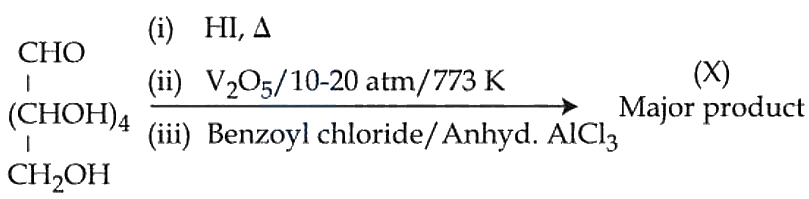
Choose an option
Show full solutionCorrect option: D
Correct answer
D
Step-by-step explanation
Step 1: The starting material is an aldohexose (like D-glucose). On prolonged heating with , it undergoes reduction to form n-hexane. This indicates that all six carbon atoms are linked in a straight chain.
(n-hexane)
Step 2: n-Hexane, when passed over heated at and pressure, undergoes aromatization (dehydrogenation and cyclization) to form benzene.
(Benzene)
Step 3: Benzene reacts with benzoyl chloride () in the presence of anhydrous to form benzophenone. This is a Friedel-Crafts acylation reaction.
(Benzophenone)
Step 4: Analyze the product (X), which is benzophenone.
The structure of benzophenone consists of two phenyl rings attached to a carbonyl group.
- Each phenyl ring contains bonds, so two rings have bonds.
- The carbonyl group () contains bond.
- Total number of bonds = .
- Total number of electrons = .
- The oxygen atom in the carbonyl group has lone pairs of electrons.
- Total number of lone pair electrons = .
Total number of electrons in the bonds and lone pairs = .
Answer:
(n-hexane)
Step 2: n-Hexane, when passed over heated at and pressure, undergoes aromatization (dehydrogenation and cyclization) to form benzene.
(Benzene)
Step 3: Benzene reacts with benzoyl chloride () in the presence of anhydrous to form benzophenone. This is a Friedel-Crafts acylation reaction.
(Benzophenone)
Step 4: Analyze the product (X), which is benzophenone.
The structure of benzophenone consists of two phenyl rings attached to a carbonyl group.
- Each phenyl ring contains bonds, so two rings have bonds.
- The carbonyl group () contains bond.
- Total number of bonds = .
- Total number of electrons = .
- The oxygen atom in the carbonyl group has lone pairs of electrons.
- Total number of lone pair electrons = .
Total number of electrons in the bonds and lone pairs = .
Answer:
Practice this on the real CBT interface
Solve this JEE Main question (and the rest of the Biomolecules chapter) on PrepSharp's TCS iON-style CBT player — with timer, bookmarks and session analytics.
Solve interactively →About this question
This is a previous-year question from JEE Main 2026, covering the Biomolecules chapter of Chemistry. PrepSharp catalogues every PYQ from JEE Main with a verified answer key and step-by-step solution prepared by IIT alumni — so you can search by chapter, topic or year and revise efficiently.