JEE Main 2026 — Biomolecules Question with Solution
JEE Main 2026 (23 January Shift 1)
Question
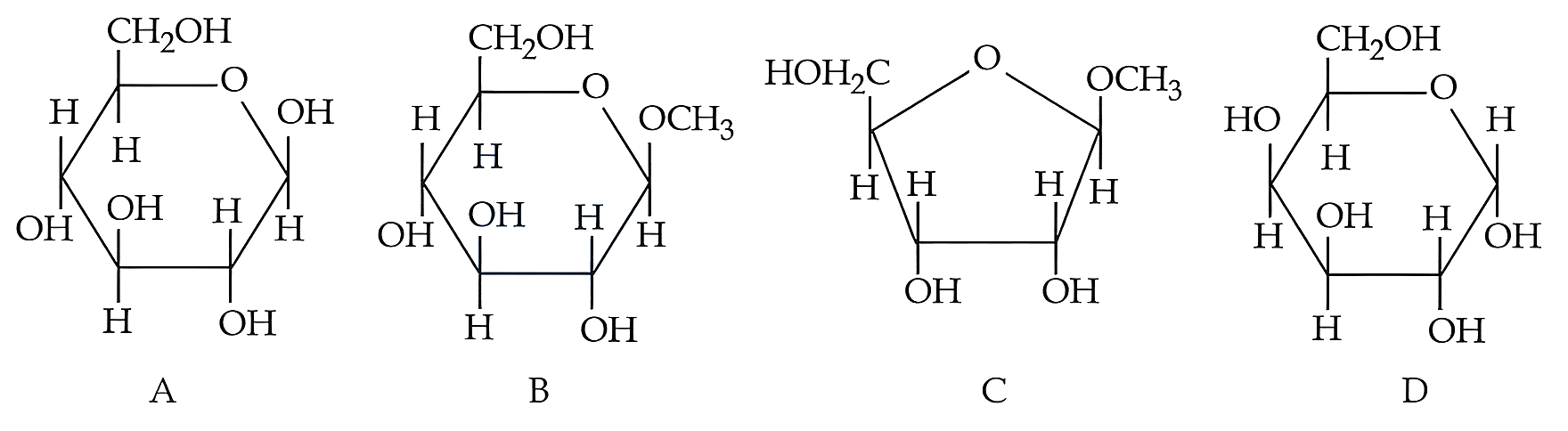
From the given following (A to D) cyclic structures, those which will not react with Tollen's reagent are :
Choose an option
Show full solutionCorrect option: D
Correct answer
DB and C
Step-by-step explanation
Tollen's reagent reacts with free aldehydes.
Structure A is a hemiacetal (reducing sugar) that exists in equilibrium with its open-chain aldehyde form, allowing it to react with Tollen's reagent.
Structure B is a glycoside (methyl glycoside or similar), where the anomeric carbon is locked in an acetal/ketal form with an -OCH₃ group, preventing ring opening and aldehyde formation, so it cannot react with Tollen's.
Structure C has a cyclic ether oxygen and lacks a free aldehyde group that can be generated under mild conditions, preventing reaction with Tollen's.
Structure D is a hemiacetal form of a reducing sugar with a free anomeric -OH, allowing equilibrium with the aldehyde form and reaction with Tollen's.
Structures B and C do not react with Tollen's reagent.
Structure A is a hemiacetal (reducing sugar) that exists in equilibrium with its open-chain aldehyde form, allowing it to react with Tollen's reagent.
Structure B is a glycoside (methyl glycoside or similar), where the anomeric carbon is locked in an acetal/ketal form with an -OCH₃ group, preventing ring opening and aldehyde formation, so it cannot react with Tollen's.
Structure C has a cyclic ether oxygen and lacks a free aldehyde group that can be generated under mild conditions, preventing reaction with Tollen's.
Structure D is a hemiacetal form of a reducing sugar with a free anomeric -OH, allowing equilibrium with the aldehyde form and reaction with Tollen's.
Structures B and C do not react with Tollen's reagent.
Practice this on the real CBT interface
Solve this JEE Main question (and the rest of the Biomolecules chapter) on PrepSharp's TCS iON-style CBT player — with timer, bookmarks and session analytics.
Solve interactively →About this question
This is a previous-year question from JEE Main 2026, covering the Biomolecules chapter of Chemistry. PrepSharp catalogues every PYQ from JEE Main with a verified answer key and step-by-step solution prepared by IIT alumni — so you can search by chapter, topic or year and revise efficiently.